A company-wide step challenge that turned everyday movement into a moment of connection for 25,000+ participants across 400+ organisations.
2 Months
Timeline
PM(*2) + Me
Team
PM(*2) + Me
Landscape

Insurance and wellness apps inherently struggle with daily retention; users simply don't check their health policies every day. Stepathon was conceptualized to solve this by introducing a fun, gamified hook. However, dropping a gamified step-tracker into a serious insurance app posed a massive UX risk. We had to design an experience that felt exciting and competitive for employees, provided actionable oversight for HR admins, and ultimately converted this new daily foot traffic into tangible sales for Pazcare’s wellness offerings.
SUMMARY
Problem
As a utilitarian InsurTech platform, the app saw infrequent use. Users only logged in for serious, high-friction tasks like claims or policy checks. We needed a strategic initiative to build a daily habit, increase Daily Active Users (DAU), and drive cross-sales without alienating the brand's core identity.
Solution
Designed "Stepathon," a gamified, cross-company step challenge. The feature included normalized leaderboards, team-based daily goals, an HR monitoring dashboard, and strategic milestone rewards (discount coupons) for in-app wellness services.
Impact
Shipped the end-to-end design for a challenge that attracted 25,000+ participants across 400+ companies, driving a massive 40% increase in daily active users and boosting health checkup revenue by 15–17%.
Operating closely with a Product Manager and Direct Manager, my workflow was highly iterative. I translated raw market data into basic IA wireframes, pitching different gamification routes (individual vs. team vs. cross-company). Once we locked in the logic, I generated multiple high-fidelity UI variations, heavily testing them internally to refine the micro-interactions and visual hierarchy before development handoff.
Journey
To ensure the feature was engaging but technically feasible, I adopted a heavy research-to-prototype pipeline. 1. Market Research & Competitor Analysis I conducted a deep-dive market study of dedicated step-counters and lifestyle-goal applications. We mapped out the pros, cons, and UX friction points of how these apps handled daily task engagement and point incentives. 2. Internal Discovery & Journey Mapping Since we wanted to keep this launch a surprise for our clients, all user research was conducted in-house. I interviewed internal users to understand what drives daily competitive engagement. This informed our user journey, focusing on a daily loop: checking points, viewing the leaderboard, and striving for daily bonus boosts. 3. Information Architecture (IA) & UI Gamification I architected two distinct portals: -The Employee App: A fun, vibrant, and highly readable interface focusing on team challenges, individual milestones, and daily point bonuses. -The HR Dashboard: A clean, data-heavy administrative view allowing HR to monitor employee progress, manage team rosters, and track overall company performance. 4. Strategic Cross-Selling (The Revenue Engine) To drive business impact, I integrated the reward system directly into Pazcare’s ecosystem. Instead of arbitrary points, milestone rewards were designed as high-visibility discount coupons for health checkups and doctor consultations, creating a frictionless funnel from the game to the checkout page.
Hurdle:
The Scale Imbalance (David vs. Goliath) Pazcare’s clients range from 30-person startups to 1,000+ employee enterprises. A traditional leaderboard would give massive companies an unbeatable, unfair advantage, instantly killing engagement for smaller teams.
Solution:
I collaborated deeply with the PM over several days to mathematically model a fair point distribution system. I designed the UX to support normalized scoring—capping team participant limits and distributing point bonuses proportionally. This ensured that a company with 4 teams had the exact same competitive footing as a company with 20 teams, maintaining a neutral, fair, and highly competitive environment.
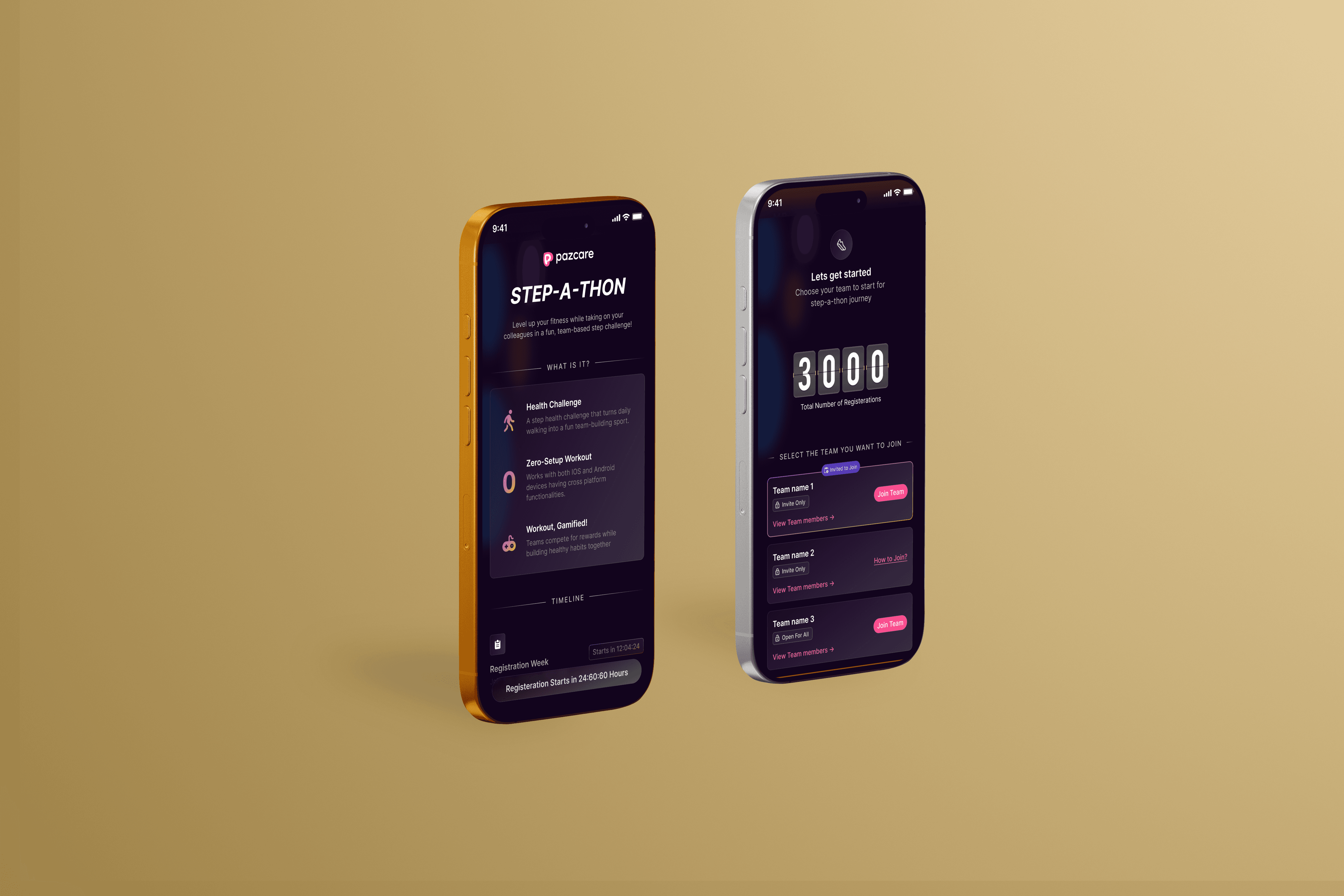
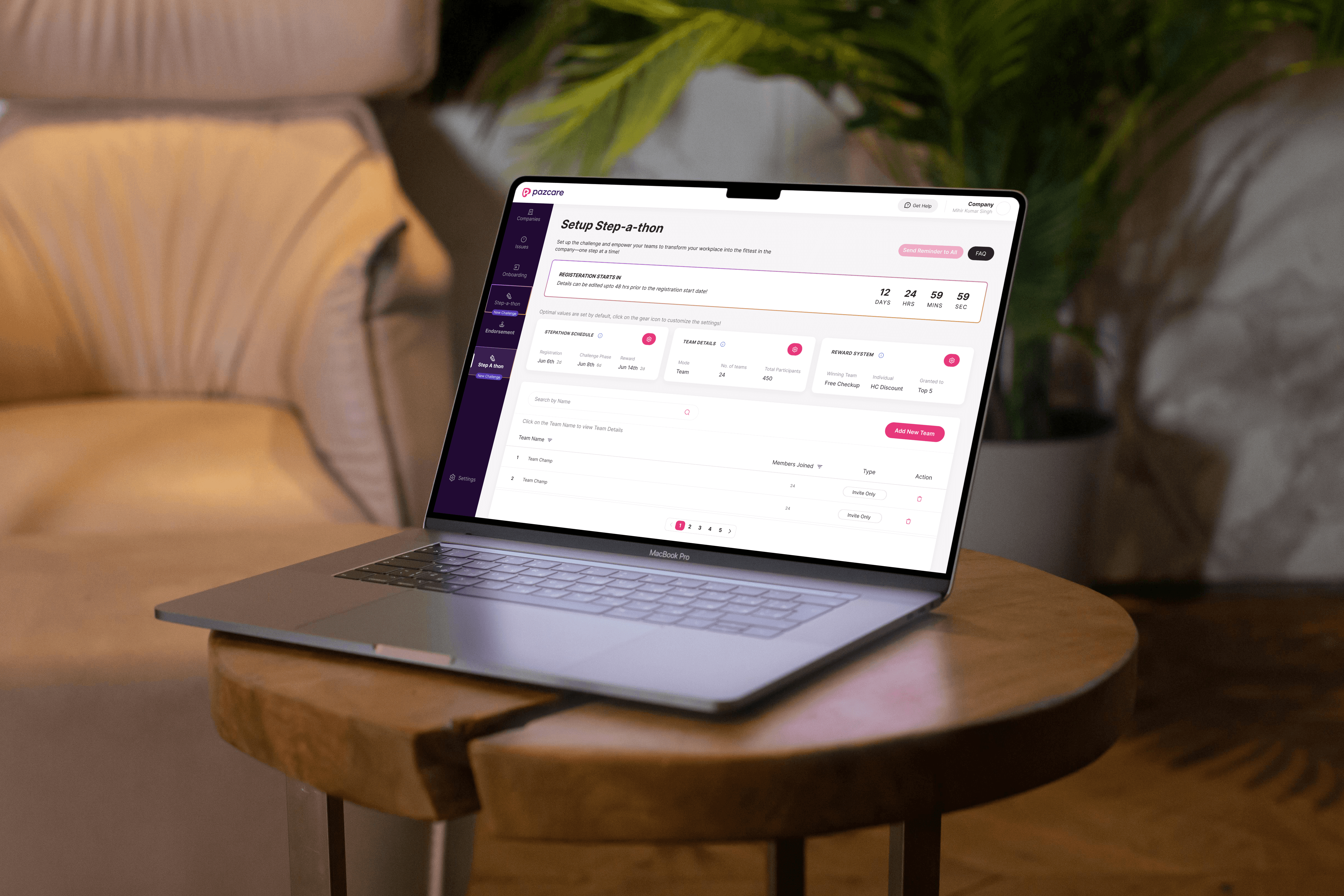
Stepathon was a massive success, effectively proving that gamification can drive serious business metrics in the InsurTech space. It not only re-engaged dormant users but also drove a massive spike in net-new app downloads from employees who had never previously installed the Pazcare app. Key Metrics Achieved: 1. +40% Increase in Daily Active Users (DAU). 2. 25,000+ Participants successfully onboarded and engaged. 3. 400+ Companies actively competing in the ecosystem. 4. +15–17% Increase in direct revenue for health checkups driven by strategic in-app reward coupons.
